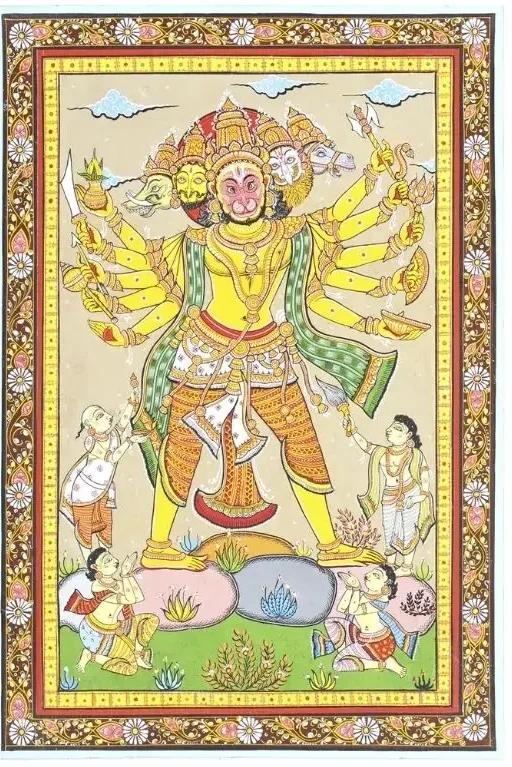
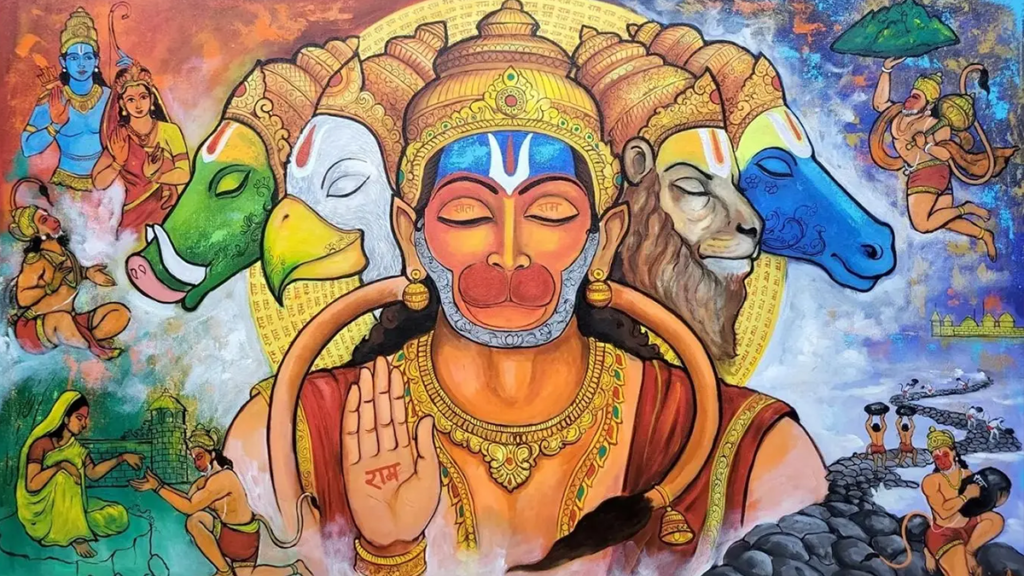
When the British writer Edward Moore first came across the Panchamukhi or five-faced image of Hanuman in the early 1800s, he asked the same question many still ask today: What is the story behind Panchamukhi Hanuman? The question remains as compelling as the form itself. Despite its immense popularity, the panchamukhi roopa of Hanuman is a mysterious deity. Yet, its sacredness has never been in doubt. For devotees all over the world, this form represents Hanuman in his most powerful and protective aspect.
Why did Hanuman become Panchamukhi?
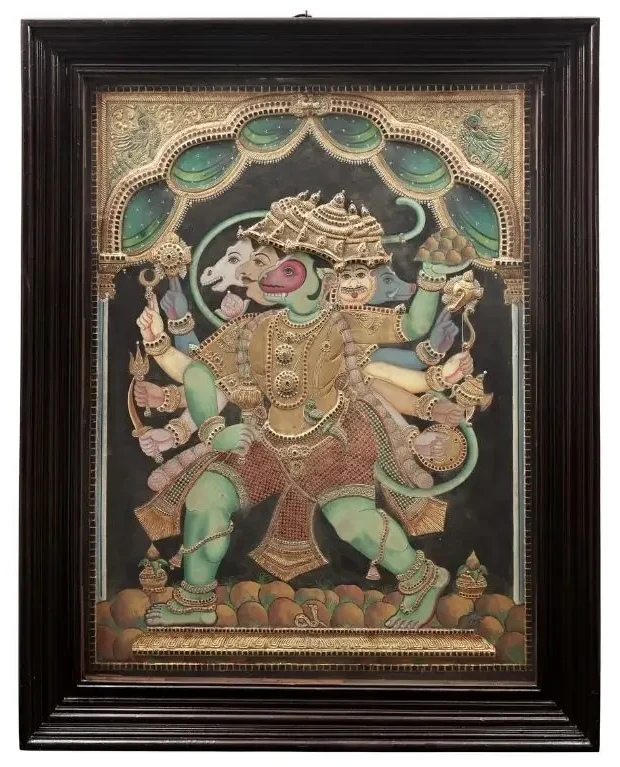
During the war in Lanka, the demon Mahiravana (or Ahi) abducted Rama and Lakshmana to the underworld. His life force was hidden in five lamps placed in different directions, and the condition for his defeat was that all five had to be extinguished at the same time. To do this, Hanuman assumed a five-faced form, facing all directions, and extinguished the lamps at once, thus ending Mahiravana’s life. In that act, the Panchamukha aspect of Hanuman was born, protector of all quarters, destroyer of darkness.
This story comes from the Krittibas Ramayana, the Bengali version of the story. While not universally accepted, it provides an explanation for why Hanuman assumed five faces to vanquish the demon king.
The Five Faces: Power in each Direction
The Panchamukha Hanuman Kavach in the Sudarshana Samhita offers a vivid visualization and iconography of Hanuman’s five-faced form:
He is described as having five faces, fifteen eyes, and ten mighty arms, panchavaktram mahabhimam, fierce and resplendent, fulfilling all desires.
1. To the east, the monkey-face of Hanuman shines like a billion suns, its sharp teeth and arched brows blazing with courage.
2. To the south, the face of Narasimha roars, terrible and radiant, destroying every shadow of fear.
3. To the west, the curved-beaked Garuda spreads his wings of strength, crushing poisons, serpents, and ghostly afflictions.
4. To the north, the dark and lustrous Varaha rises, conqueror of the underworld, destroyer of beasts, plagues, and feverish spirits.
5. Above all, the horse-faced Hayagriva blazes forth, the embodiment of divine knowledge and victory.
Together, these five faces guard the devotee from every direction, east, south, west, north, and above, forming a sacred circle of protection and power.